
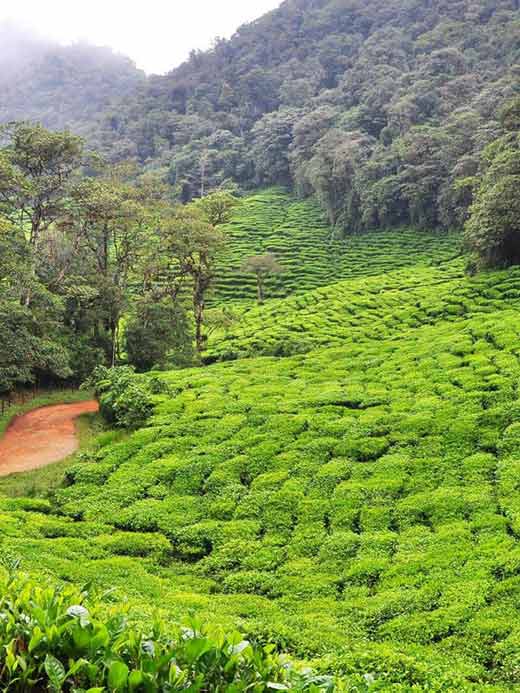
Whether you visit our shop in downtown Charleroi or shop on our website, you’ll be spoiled for choice when ordering your cup or bag of coffee. Arabica or Robusta? And where is it from? With Cafés Van Hove, you’ll travel throughout the coffee belt—that vast region north and south of the equator, a tropical zone where temperature and altitude conditions are ideal for growing coffee.
We source our coffee from several continents: the Americas (Costa Rica, Brazil, Guatemala, Mexico, Colombia, Peru, Jamaica, and the Dominican Republic), Africa (Burundi and Ethiopia), Asia (
, and Sumatra), and Oceania (Papua New Guinea). We also offer blends of coffee from different origins.
Arabica vs. Robusta
Whether in terms of growing conditions, composition, or taste, Arabica and Robusta are quite different. ARABICA is grown at high altitudes (often between 800 and 2,000 meters), in moderate temperatures and with a certain level of humidity. Its aromas are quite complex, with floral or slightly tart notes. It is milder and less bitter on the palate than Robusta, since it contains less caffeine.
Robusta grows at lower altitudes and is more tolerant of high temperatures. It is often bolder and more bitter, with earthy or woody notes. It contains nearly twice as much caffeine as Arabica. This variety is commonly used in coffee blends, whereas Arabica is typically preferred for specialty coffees.
The distinctive characteristics of coffee from the world’s top 10 countries
BRAZIL (primarily Arabica)
Brazilian Arabica is mild and exceptionally refined. It features aromatic notes of nuts (particularly hazelnut) and chocolate. It has low acidity. These Arabica beans vary greatly depending on the region, given the country’s size. Brazil accounts for nearly 40% of global production.
The Robusta beans from this country have more pronounced flavors and are frequently used in blends.
VIETNAM (primarily Robusta)
Vietnamese Robusta (from the world’s second-largest producer) is full-bodied, very bitter, low in acidity, and high in caffeine. It has aromas of hazelnut, chocolate, and cocoa. It is often used in blends. Vietnamese Arabica is characterized by fruity, floral, caramel, and vanilla notes.
COLOMBIA (Arabica)
This coffee is renowned for its consistency and high quality. It is perfectly balanced and has a medium acidity. It features notes of caramel and fruity aromas (primarily red berries).
INDONESIA (Arabica and Robusta)
Indonesian coffees, which have moderate acidity, are spicy and rich in aroma. They feature earthy notes, sometimes with a smoky quality. Some exhibit aromas of chocolate, caramel, and precious woods.
ETHIOPIA (Arabica)
The historic birthplace of coffee cultivation produces coffees that vary considerably from region to region. They are quite acidic and have complex flavor profiles with notes of flowers, red berries, and citrus.
HONDURAS (Arabica)
The quality of Honduran coffees has improved significantly in recent years. They have moderate acidity, are mild, and are characterized by notes of tropical fruit. They are often used in coffee blends.
INDIA (Arabica and Robusta)
Coffee beans grown in India are exposed to humid winds and monsoons, which reduces their acidity. Since they are often grown in the shade alongside spices, they have distinctive woody and spicy notes—highly characteristic of the region. Depending on the processing method, they may also feature notes of chocolate, flowers, and dried fruit.
UGANDA (mainly Robusta)
This country produces very high-quality Robusta. It is bold, earthy, and low in acidity, with notes of bitter cocoa. Its Arabica, which is more acidic, tends to have fruity and floral notes.
MEXICO (Arabica)
Mexican coffees are generally mild, easy to drink, and often organic. They have low acidity. Notes of nuts and chocolate dominate.
PERU (Arabica)
These Arabica beans, with their moderate acidity, bring out the beans’ natural sweetness. They are fairly light and offer slightly floral and fruity aromas, with hints of honey or cane sugar.
Article written byPierre Danvoyefor Cafés Van Hove
